
A migration to the Cloud is becoming an essential step for companies and can feel like a long journey. It is a process that looks long and complex, but what are the most decisive factors today. How can a company’s transition to the Cloud be made easier? Be ready for the great migration.
Table of contents
AWS migration #1: Seeing the overall picture
AWS migration #2: Entering a new world
AWS migration #3: Considering the Build phase
AWS migration #4: Guaranteeing business continuity
AWS migration #5: Mastering the Run phase
AWS migration #6: Trusting DevOps experts / Developers
AWS migration #7: The different Regions available
AWS migration #8: Why back up in the Cloud?
AWS migration #9: The new uses
AWS migration #1: Seeing the overall picture
Among the various Cloud services offered by the market, the main uses are the hosting of websites, the storage and retrieval of data, not forgetting data analysis to improve the steering of the company’s activities.
The Cloud is today an essential tool in the digitalisation of companies, one that makes this transformation easier and reduces its cost. The benefits of Cloud computing are numerous, and represent a real opportunity for companies that are increasingly inclined to adopt it.
AWS migration #2: Entering a new world
In a world where the Cloud comes first, new skills are essential. It is important to stress that 81% of French companies (89% worldwide) that have completed their migration to a “Cloud first” model reported that their team is not able to meet the needs of a Cloud migration and does not have the skills required to make it a success. Moreover, a large majority of the people surveyed (92% in France and 88% worldwide) believe that the Cloud could be, in part, an IT service in its own right, or even designed through outsourcing.
If companies use hosting and Cloud services today, it is because a wide range of providers meet their needs. Public Cloud infrastructure providers, used by 69% of respondents, are the most common, followed by managed hosting providers, used by 26% of companies.
AWS migration #3: Considering the Build phase

Many companies think that deploying their infrastructure in the Cloud simply means moving their existing information system to the Cloud. For reasons of performance, of user experience, but above all for reasons of cost, it is crucial to rethink architectures and processes. Before switching over, it is therefore essential to carry out an architecture study, often referred to as the “Build”.
The aim of this preliminary phase is to optimise the return on investment of the Cloud solution. It also involves breaking down any application silos and assessing the impact on operations. The Build phase must be followed by a financial study in order to assess the budget and recurring costs.
AWS migration #4: Guaranteeing business continuity
Next, it is important to define the constraints related to business continuity during the migration phase. Is it conceivable to shut down the existing information system and then connect to the Cloud?Or must activity be maintained during the AWS migration phase?
Depending on the constraints related to the business, different migration methodologies will have to be considered:
Method 1. The “lift and shift” consists of migrating an application from one environment to another without carrying out any redesign or code modification.
Method 2. The “replatform” aims to move your applications to the Cloud with a small upgrade, using a Cloud-managed database offering or by adding auto-scaling (elasticity of certain applications) enabled by automation.
Method 3. The “refactoring” involves a more advanced process, requiring you to rethink the architecture and the code of your existing applications in order to be able to optimise Cloud-native features. This approach is the longest to put in place. But it will allow you to reduce the cost of using Cloud services immediately.
AWS migration #5: Mastering the Run phase
To master the run phase, all the operating procedures will have to be rewritten. The administration teams will first have to be trained in the new Cloud practices.
And new tools will have to be deployed to give visibility over the performance the security and the availability of every element in the Cloud, so as to guarantee the operational upkeep of the whole.
AWS migration #6: Trusting DevOps experts / Developers
More than expertise, it is method: being supported by a provider whose experience is recognised is a guarantee of success for an AWS migration project.
The partner will support change management, define the Build and Run phases, and above all carry out the transfer of skills to the operations teams. Or offer a managed services contract with the expected service levels.
AWS migration #7: The different Regions available
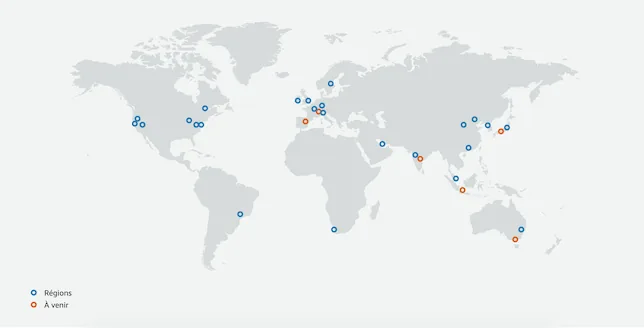
Cloud Providers are large resource centres available all over the world.Resources are accessible flexibly. The customer can easily increase or reduce the capacity available for the data it holds according to its needs.
Cloud Providers therefore have several centres in different Regions for managing your servers, data, resources and other enterprise software. You will have to choose the region closest to your needs and that brings together the services you need. Warning: Some regions do not have every service available in the catalogue.
AWS migration #8: Why back up in the Cloud?
Setting up a dematerialised backup answers certain questions concerning the Cloud. Harnessing the power of remote backup solutions to offer backup services there with maximum security optimisation.
Its biggest advantage is that it offers great flexibility. The solutions are rented on demand, thanks in particular to the backup mode. They generally require no hardware investment, setup is quick and billing is based on usage.
The Cloud also ensures the confidentiality of the data that is hosted, even the most sensitive. Entrusting a professional host or a provider with backing up your data on a third-party site is a significant guarantee of security to anticipate any risk.
AWS migration #9: The new uses
Today the need to speed up and industrialise processes is a direct impact of the new communication trends. Teamwork is brought to the fore by creating skill pools in order to accelerate digital challenges.
The process consists of better targeting reference data in order to deploy a common language. Optimising the reading of data upstream makes setting up a project easier and faster.
Data governance is today essential to any optimisation of the information system.
equipping yourself with effective tools in line with the critical challenges of digital.
This trend is the major challenge for companies in 2017. Many teams have failed because they could not connect their business tests to Core IT.